Fiberglass.
Advantages and cost
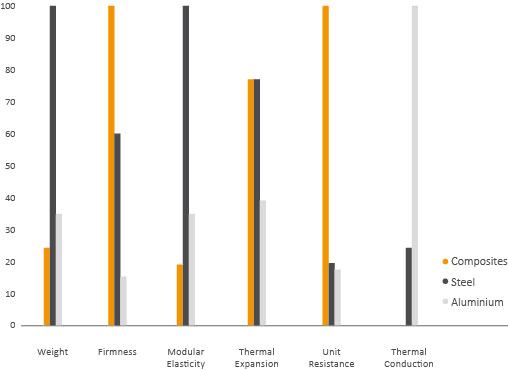
Advantages and cost compared to stainless steel products. The combination of low weight, corrosion resistance, and high strength gives GRP both technical and economic advantages throughout the product’s lifespan.
Fiberglass (GRP) – advantages and cost compared to stainless steel.
When it comes to material choices for industrial structures, GRP (glass reinforced plastic) is an increasingly popular alternative to stainless steel – especially in environments with high moisture loads, chemical exposure or electrical hazards. Thanks to the combination of low weight, corrosion resistance and high strength, GRP offers both technical and economic benefits over the entire lifetime of the product.
Advantages of GRP:
- Corrosion resistance: GRP is completely corrosion-free and is not affected by moisture, salt water or most chemicals. Stainless steel often requires surface treatment and regular maintenance to avoid corrosion – especially in marine environments or chemical plants.
- Lightweight and easy to handle: GRP weighs around 25-30% of the equivalent steel structure, making it significantly easier to transport, lift and install – even at high altitudes or in hard-to-reach places. This reduces the need for heavy lifting equipment and significantly lowers installation costs.
- Electrical insulation: Unlike metal, GRP is completely non-conductive and requires no grounding, making it safer to use in electrically sensitive environments or areas.
- Low life cycle cost: Although GRP sometimes has a higher initial cost than stainless steel, this is quickly offset by significantly lower maintenance costs, no risk of corrosion and a much longer service life.
- Dimensional and shape stability: GRP retains its dimensions even under large temperature variations and vibrations, while steel can suffer stress cracking under prolonged mechanical stress.
- Ease of processing: GRP profiles can be easily cut, drilled and shaped with standard hand tools, without the need for welding or specialized equipment. This simplifies both production and on-site assembly.
- Chemical resistance: GRP can be customized to withstand specific chemical environments through resin selection, making it a flexible option in chemical processes and water treatment.