Why slip accidents still happen – and how to prevent them
Why slip accidents still happen – and how to prevent them.
Slip accidents remain one of the most common causes of injuries in both workplaces and public environments. Even when the risks are well known, the same issues keep recurring.
In most cases, it’s not a lack of awareness – it’s about how and when action is taken.
Risks are often identified early. You know an entrance becomes slippery when it rains, that an industrial walkway is exposed to spills, or that a staircase wears down over time. Still, action is delayed – or temporary fixes are chosen that don’t hold up in the long run.
Common causes of slip hazards.
Several recurring factors are behind most slip accidents:
- Materials that are not suited to the environment
- Wear and tear that reduces grip over time
- Temporary solutions becoming permanent
- Action only taken after a problem has already occurred
This means many surfaces work “well enough” – until they suddenly don’t.
Slip risks vary – and require different solutions.
A common challenge is applying the same type of solution across different environments, even though conditions vary significantly. Industrial environments with liquids, heavy loads and high wear place very different demands compared to a public entrance. Stairs behave differently than flat surfaces, and outdoor areas are constantly affected by weather and temperature.
This is why a standard solution is rarely enough.
How to prevent slip accidents in practice.
Reducing the risk of slip accidents requires a more considered approach. It’s not just about fixing a problem – it’s about choosing the right solution from the start. That means:
- Adapting anti-slip solutions to the specific environment
- Choosing materials that withstand long-term wear and load
- Working proactively instead of reacting after incidents
When these elements are in place, not only is safety improved – ongoing maintenance is also reduced.
Vilka lösningar finns?
What solutions are available?
Depending on the environment and needs, several approaches can be used:
- Anti-slip solutions for industrial environments – designed for durability and high grip under demanding conditions
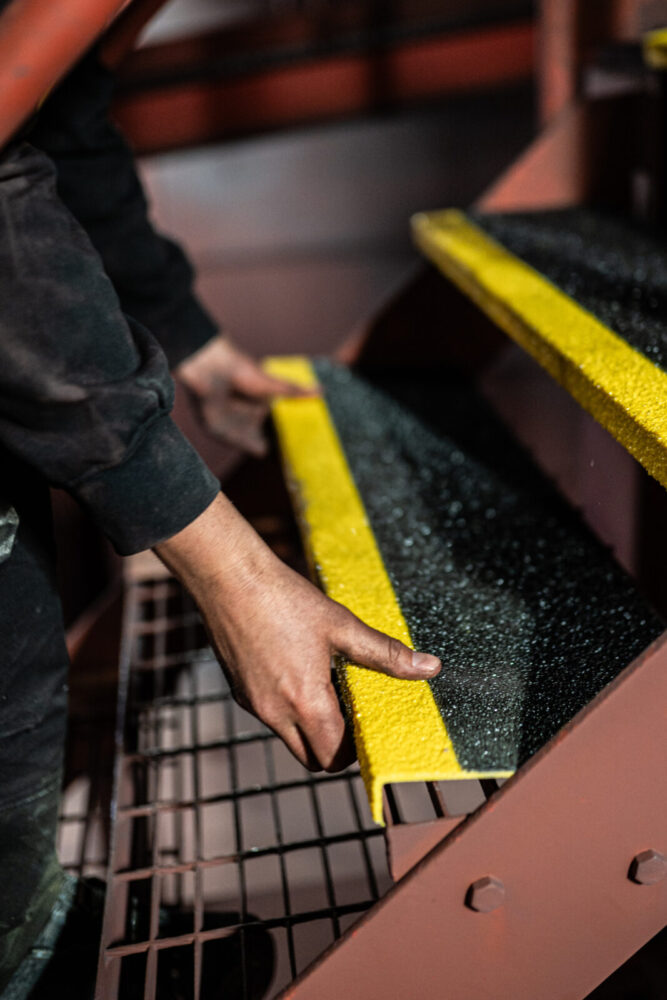
- Anti-slip solutions for stairs and entrances – improving safety in high-traffic areas
- UV-cured line marking – creating clear, durable and slip-resistant markings in warehouses and production areas
- Heated mats – preventing slip hazards caused by snow and ice in exposed outdoor areas
The common denominator is that each solution must be adapted to the environment it’s used in.
We work with analysing risk areas and developing solutions tailored to both the environment and how it’s used. This can involve anything from industrial flooring to public entrances or outdoor areas where conditions change quickly.
The goal is simple: to create safe surfaces that perform over time. Get in touch – we’ll help you find the right solution for your environment!
FAQ – Slip accidents and anti-slip solutions
- What is the most common cause of slip accidents?
- The most common causes are a combination of unsuitable materials, wear, and external factors such as water, dirt or ice. In many cases, risks are known but not addressed in time.
- How can slip accidents be prevented in workplaces?
- By working proactively with the right type of anti-slip solution adapted to the environment and level of use. Long-term durability is key.
- What anti-slip solution is best for industrial environments?
- Industrial environments require highly durable, high-friction solutions that can handle liquids, chemicals and heavy loads.
- How can safety be improved in stairs and entrances?
- By using anti-slip products designed for high traffic and changing conditions, such as stair nosings, profiles or surface treatments.
- When should anti-slip solutions be installed?
- Ideally before problems occur. Preventive measures are both safer and more cost-effective.
- How do heated mats prevent slipping?
- Heated mats keep surfaces free from snow and ice, reducing the need for manual snow removal and de-icing.
- How long do anti-slip solutions last?
- It depends on material, load and environment. The right solution in the right place can last for many years with minimal maintenance.
- What should be considered when choosing anti-slip solutions?
- How the surface is used, what it’s exposed to, and the required level of safety and durability.
